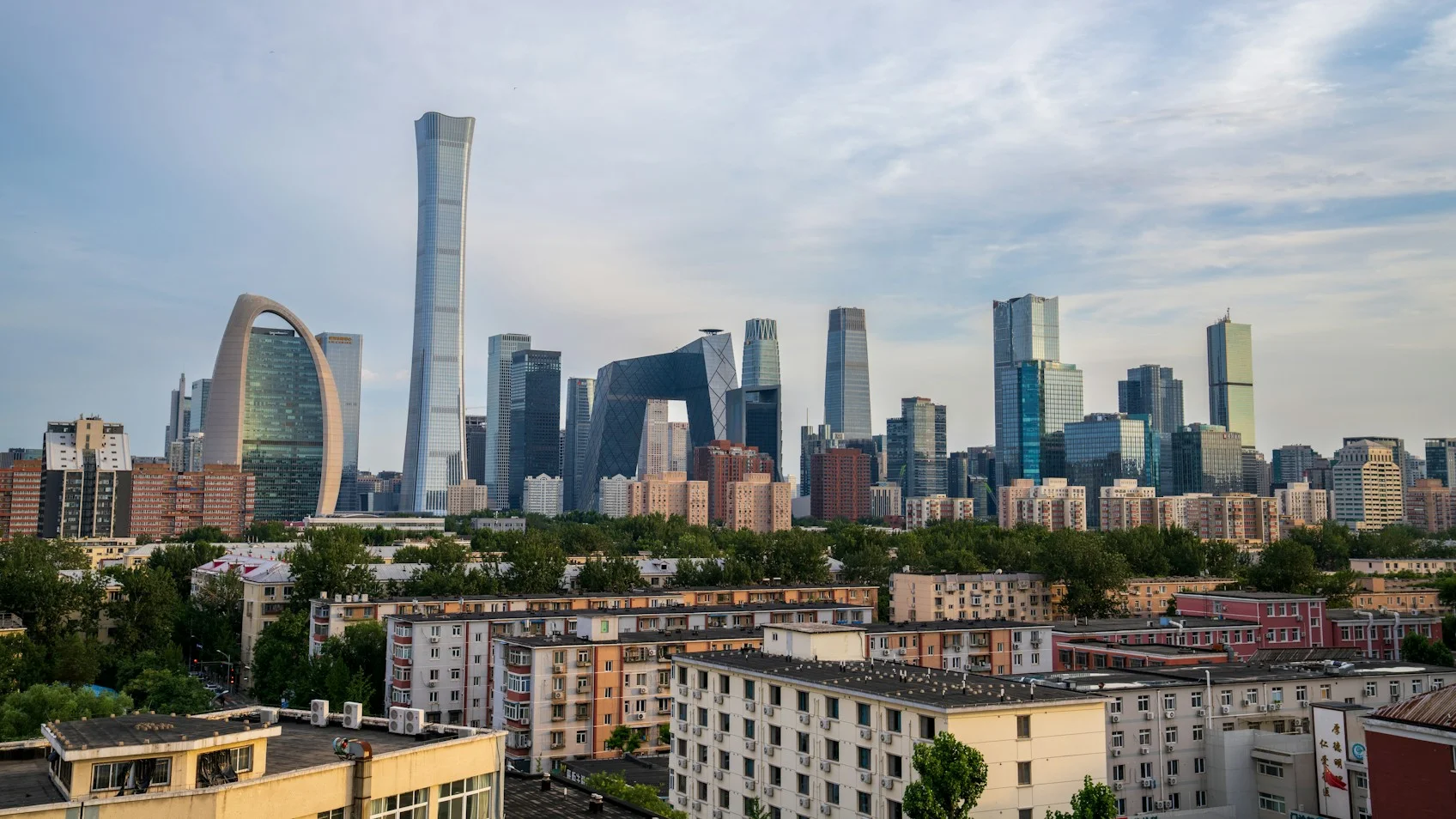
Beijing is where China's rules get made. As the capital, it is home to the central government ministries and regulators, the head offices of many of the country's largest state-owned companies, and the embassies and chambers of commerce that foreign firms deal with. In 2025 it became the second Chinese city after Shanghai to pass 5 trillion yuan in GDP, reaching 5.21 trillion yuan.
Beijing is a services and technology city first. Zhongguancun in Haidian district is China's best-known tech cluster, and the city has more than 30,000 national high-tech enterprises and 116 unicorns. Much of its newer manufacturing, including car and biotech plants, sits in the Beijing Economic-Technological Development Area (Yizhuang), in the south-east of the city.
Here's what you need to know before hiring.
Quick Facts
| Category | Details |
|---|---|
| City Tier | Tier-one city; national capital and direct-controlled municipality |
| Dialect | Beijing Mandarin, the basis of standard Mandarin |
| Population | Approx. 21.8 million (end of 2025) |
| Airports | Beijing Capital International (PEK) and Beijing Daxing International (PKX) |
| Logistics Infrastructure | Tianjin Port is the nearest major seaport; China (Beijing) Pilot Free Trade Zone; Tianzhu and Daxing Airport comprehensive bonded zones |
Who Should Consider Hiring in Beijing?
If you need staff close to government, regulators or Chinese head-office clients, Beijing is hard to avoid. At the end of 2025 the city had 284 recognised regional headquarters of multinationals and 332 foreign-invested R&D centres. Foreign investors set up 2,405 new companies in Beijing in 2025, up 19.5% on the year, although actual foreign investment fell 5% to $6.87 billion.
What Beijing is not is a manufacturing or low-cost location. For more than a decade, Beijing has been moving factories and other activities it doesn't see as part of its role as the capital out to neighbouring Tianjin and Hebei, so it limits new factories. Staff are also expensive to employ: social insurance is charged on a salary of at least 7,270 yuan a month, even for people who earn less than that. That minimum is close to Shanghai's 7,546 yuan. If your operation depends on factory labour or low payroll costs, Tianjin or cities further south will suit you better.
Talent Profile
Beijing's talent pool is shaped by its universities, its government institutions and its tech sector. Peking University and Tsinghua University are both here, and Zhongguancun remains the centre of China's AI and software industry. Expect strong competition for experienced engineers and for anyone with government affairs experience.
| Job Type | Popular Roles |
|---|---|
| AI & Software | Machine learning engineers, backend developers, data scientists, product managers |
| Biomedicine & Medical Devices | R&D scientists, clinical research associates, regulatory affairs specialists, medical affairs managers |
| Finance & Professional Services | Compliance officers, analysts, auditors, in-house legal counsel |
| Government Affairs & Policy | Government relations managers, public affairs specialists, policy analysts |
| Automotive & Advanced Manufacturing | Process engineers, quality engineers, supply chain planners (mainly in Yizhuang and Shunyi) |
English Proficiency
Beijing scores 509 on the EF English Proficiency Index, well above the Chinese mainland's 466. It sits just behind Hangzhou (517), Nanjing (511) and Shanghai (511). English is strongest among graduates of the top universities and staff at foreign firms, embassies and international organisations.
Salaries
The minimum wage is 2,540 yuan per month ($381) and 27.7 yuan per hour ($4.15) for part-time work, effective from Sept. 1, 2025. Beijing's hourly minimum is the highest in China. Part-time staff who work on a statutory holiday must be paid at least 65.1 yuan per hour.
Urban per-capita disposable income reached 96,292 yuan in 2025, up 4.1% on the year.
Social Insurance
Beijing sets its own social insurance base each year. The contribution base (the salary figure used to calculate contributions) is bounded by a floor and a ceiling. For the year starting July 2026 the range is 7,270 – 36,348 yuan, published on 21 August 2026 and backdated to July. Employers can settle any shortfall caused by the new limits by the end of December 2026 without late fees.
The floor is almost three times the minimum wage, so social insurance adds a lot to the cost of junior hires.
Example:
- If you hire someone at 12,000 yuan per month, their pension contribution is calculated on their full salary. If you hire someone at 40,000 yuan per month, it is calculated as if they earn 36,348 yuan (the maximum base). If you hire someone at 5,000 yuan, it is calculated on 7,270 yuan (the minimum base).
Here's how the contribution rates break down in Beijing:
| Insurance Type | Employer Rate | Employee Rate |
|---|---|---|
| Pension | 16% | 8% |
| Medical (incl. maternity insurance) | 9.8% | 2% + 3 yuan for the major medical expense fund |
| Work Injury | 0.2–1.9% (industry-rated) | 0% |
| Unemployment | 0.5% | 0.5% |
Housing Fund
Both employers and employees contribute to the housing fund in Beijing. The contribution rate is set between 5% and 12%, with both parties using the same rate, and each company chooses its rate within that range. The base runs from July to June: for 2026–27 the ceiling is 36,348 yuan and the floor is 2,540 yuan, the same as the minimum wage.
To understand how these figures impact your company payroll cost, please use our salary calculator!
Leave Policies
Beijing follows its own leave rules under the Beijing Population and Family Planning Regulations. Public holidays don't count towards the leave below. Employers must pay wages as normal during marriage, maternity and paternity leave.
| Leave Type | Entitlement | Notes |
|---|---|---|
| Marriage Leave | 10 days | 3 days national standard + 7 days under the Beijing regulations |
| Maternity Leave | 158 days | 98 days national + 60 days extended leave. Can be extended by a further 1–3 months with the employer's agreement. Difficult births add 15 days; multiple births add 15 days per additional baby |
| Paternity Leave | 15 days | Wages cannot be reduced during the leave |
| Parental Leave | 5 working days per year, each parent | Until the child turns 3. With the employer's agreement, couples can share their days, up to 10 working days in total |
| Only-Child Carer Leave | 10 working days per year | For only children whose parents need care |
| Annual Leave | 5–15 days | Follows national standard, based on years of service |
Sick Leave
Sick leave entitlements depend on the employee's length of service and medical documentation. Under the Beijing Wage Payment Regulations, sick pay cannot be lower than 80% of the local minimum wage, or 2,032 yuan a month.
Overtime
Beijing's Wage Payment Regulations use the national overtime rates: at least 150% for extra hours on working days, 200% for rest days if no time off in lieu is given, and 300% for statutory holidays. Two local points are worth knowing:
- Staff on an approved non-fixed working hours system are not covered by these overtime rules, including on statutory holidays.
- On partial holidays such as Women's Day and Youth Day, staff who work as normal don't have to be paid overtime.
High Temperature Subsidy
Beijing's high temperature subsidy runs from June to August, a shorter season than most southern cities.
- Employees working outdoors must be paid at least 180 yuan per month
- Employees in indoor workplaces at 33 C or above must be paid at least 120 yuan per month
- The subsidy must be paid in cash; cooling drinks and other supplies cannot replace it
Beijing summers are short but hot, with July and August temperatures regularly above 35 C. Build the subsidy into budgets for delivery, construction, logistics and outdoor events staff.
Ready to Hire in Beijing?
Ready to hire in Beijing without setting up a local entity? Talk to us about our China-focused EOR service and start onboarding talent in weeks.