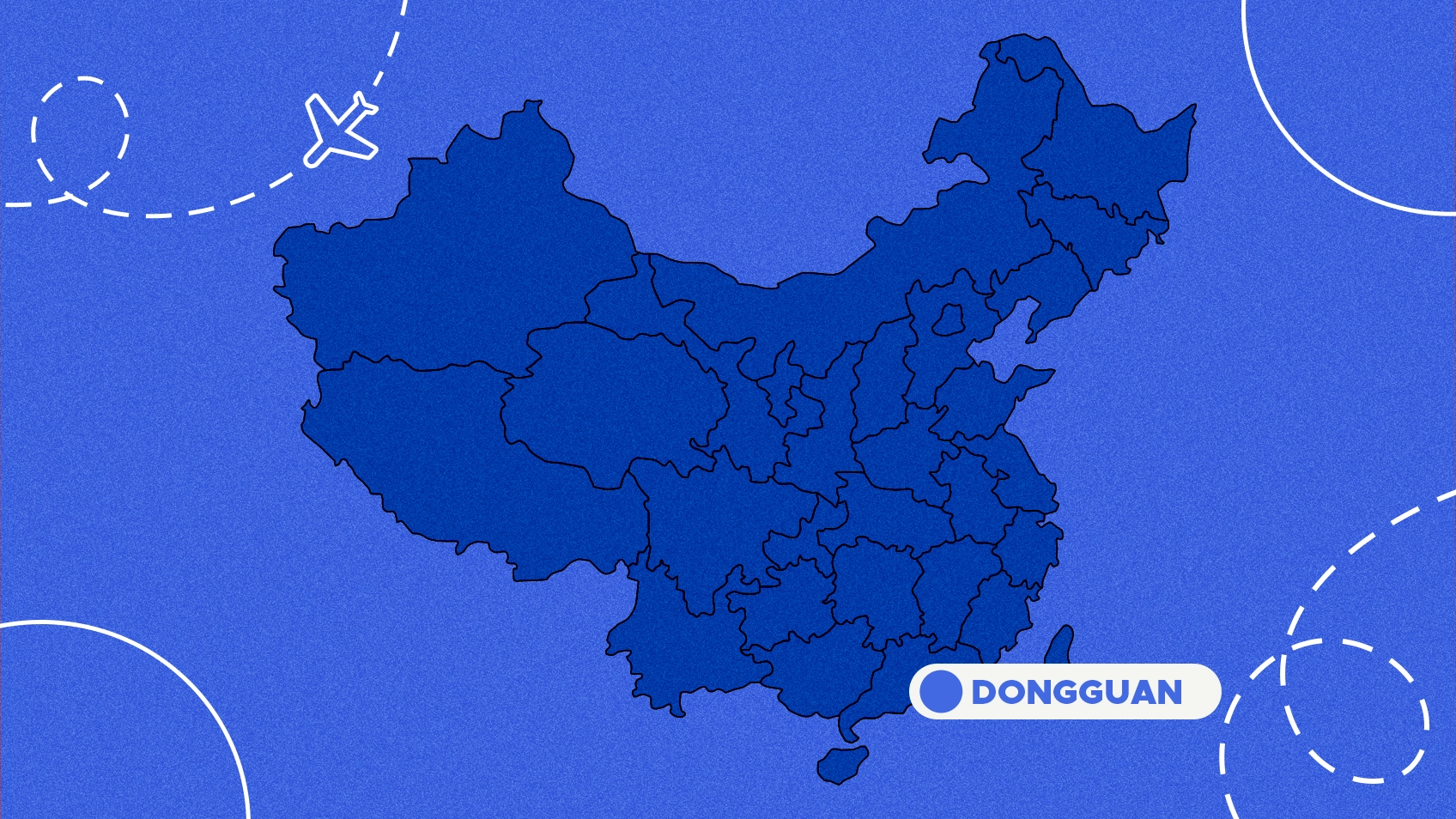
If China has a single city that captures what “the world’s factory” really means, it’s Dongguan. Wedged into the Pearl River Delta between Guangzhou and Shenzhen, Dongguan spent four decades as the place where global consumer goods were physically made. The toy and garment workshops are still there, but they now sit alongside Huawei’s largest R&D base, the headquarters of OPPO and vivo, and one of the densest electronics supply chains on earth.
For employers, Dongguan offers deep, advanced manufacturing capability inside the Greater Bay Area, at costs below neighbouring Shenzhen, with the talent and supplier ecosystem to match. Here’s what you need to know before hiring.
Quick Facts
| Category | Details |
|---|---|
| City Tier (Yicai Global) | New First-Tier (Rank 13 in 2025) |
| Dialect | Cantonese and Hakka locally; standard Mandarin universal in business |
| Population | 10.49 million permanent residents (registered population around 3.08 million; the large majority are migrants) |
| Airports | No commercial airport of its own; served by Shenzhen Bao’an International (SZX) and Guangzhou Baiyun International (CAN) |
| Logistics Infrastructure | Centre of the Guangzhou–Shenzhen–Hong Kong technology corridor; dense Greater Bay Area road, rail and port links |
Who Should Consider Hiring in Dongguan?
Dongguan is best suited to companies in electronics and smart device manufacturing, advanced and precision equipment, robotics and automation, and traditional consumer goods sectors such as furniture, toys, textiles and footwear. It also appeals to firms seeking an R&D or engineering presence connected to Shenzhen’s innovation ecosystem without the city’s higher cost base.
Talent Profile
Dongguan’s workforce is built for manufacturing. The city’s permanent population of over 10 million is overwhelmingly made up of migrant workers, giving employers access to a large and flexible labour pool for production roles. At the higher end, Dongguan has worked hard to attract engineering and technical talent, particularly around the Songshan Lake area.
| Job Type | Popular Roles |
|---|---|
| Electronics & Smart Devices | Production line operators, process and test engineers, quality inspectors, supply chain coordinators |
| Advanced Equipment & Robotics | Automation engineers, mechanical and mould-tool specialists, R&D technicians, equipment maintenance |
| Traditional Consumer Goods | Production managers, QC officers, plant operators, sourcing and merchandising staff |
| Logistics & Trade | Warehouse and operations managers, customs specialists, freight coordinators, cross-border e-commerce ops |
English Proficiency
Guangdong scores in the “moderate” band on the EF English Proficiency Index, stronger than most inland provinces, helped by the province’s long export-trade history and proximity to Hong Kong. Within Guangdong, however, Dongguan’s English-speaking talent pool is shallower than Guangzhou’s or Shenzhen’s, reflecting its manufacturing rather than corporate-services base. Expect to pay a premium for genuinely bilingual hires and to plan translation support for most internal communications.
Salaries
The minimum wage rose to 2,080 yuan per month (around $288) on 1 March 2025, with a part-time hourly rate of 19.8 yuan ($2.74). Dongguan sits in Guangdong’s Category 2 bracket — the same tier as Foshan, Zhuhai and Zhongshan, and below the Category 1 rates that apply in Guangzhou and Shenzhen.
In practice, manufacturing wages in Dongguan run well above the statutory floor, particularly for skilled and engineering roles around the Songshan Lake electronics cluster, where employers compete directly with Shenzhen for talent.
Social Insurance
Dongguan sets its own social insurance contribution bases and rates within the Guangdong provincial framework. The contribution base (the salary figure used to calculate contributions) is bounded by floor and ceiling values updated annually.
Example:
- If you hire someone at 6,000 yuan per month, their pension contribution is calculated on their full 6,000 yuan salary.
- However, if you hire someone at 35,000 yuan per month, their pension contribution is calculated as if they earn 27,501 yuan (the maximum base).
Here’s how the contribution rates break down:
| Insurance Type | Contribution Base Range (Monthly) | Employer Rate | Employee Rate |
|---|---|---|---|
| Pension | 4,767 – 27,501 yuan | 16% | 8% |
| Medical (incl. maternity insurance) | 4,767 – 27,501 yuan | 3% | 0.5% |
| Work Injury | Based on actual salary | 0.4% | 0% |
| Unemployment | 1,900 – 23,442 yuan | 0.8% | 0.2% |
Housing Fund
Both employers and employees contribute to the housing fund in Dongguan. The contribution rate is set between 5% and 12%, with both parties using the same rate. Each company chooses one rate, applied uniformly across all employees. The contribution base is bounded by a local floor (linked to the minimum wage) and a ceiling (linked to local average wage data), and is adjusted annually.
To understand how these figures impact your company payroll cost, please use our salary calculator!
Leave Policies
Dongguan follows Guangdong’s provincial leave rules, set principally by the Guangdong Population and Family Planning Regulations.
| Leave Type | Entitlement | Notes |
|---|---|---|
| Marriage Leave | 3 days | Per national standard; Guangdong does not add provincial bonus marriage days |
| Maternity Leave | 178 days | 98 days basic maternity leave + 80 days Guangdong “reward” leave. Difficult births add 30 days; multiple births add 15 days per additional baby |
| Paternity Leave | 15 days | Paid as normal working time, with no effect on benefits or attendance bonuses |
| Parental Leave | 10 days per year, each parent | Available to both parents annually until the child turns 3; cannot be stacked across multiple children |
| Elderly Care Leave | 5 days per year (up to 15 if a parent is hospitalised) | For only-children whose parents are 60 or older, subject to provincial conditions |
| Annual Leave | 5–15 days | Follows national standard, based on years of service |
Note for employers: Guangdong’s 178-day maternity entitlement splits into two funding streams — the 98-day basic period is covered by maternity insurance, while the 80-day reward period is generally paid by the employer. Factor this into team and budget planning.
Sick Leave
Sick leave entitlements depend on the employee’s length of service and medical documentation. Sick-leave pay cannot be lower than 80% of Dongguan’s local minimum wage.
High Temperature Subsidy
Guangdong operates a mandatory high temperature subsidy that applies in Dongguan. Employers must pay it to employees who work in high-temperature conditions during the hot months.
- The Guangdong subsidy is 300 yuan per month, payable across the June-to-October period for employees exposed to high-temperature work.
- It must be paid in cash and cannot be substituted with cooling drinks or other supplies.
- The subsidy is in addition to the employee’s normal wage and cannot be counted as part of the minimum wage.
Given Dongguan’s hot, humid subtropical summers, this is a real consideration for any employer with outdoor or non-air-conditioned operations, including construction, logistics yards, and certain factory environments.
Ready to Hire in Dongguan?
Ready to hire in Dongguan without setting up a local entity? Talk to us about our China-focused EOR service and start onboarding talent in weeks.