
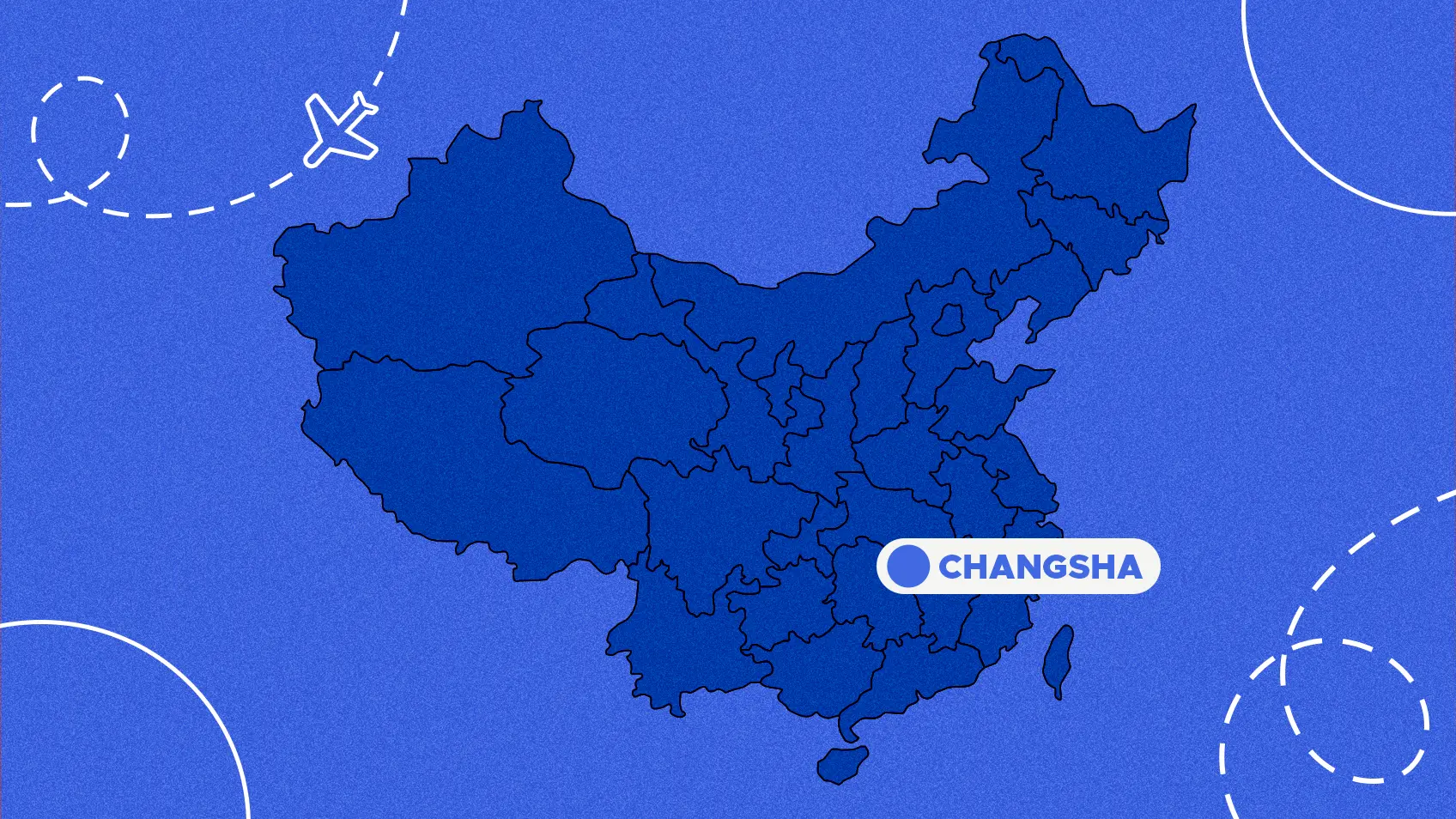
Changsha doesn’t get much press. The capital of Hunan province rarely features in the same breath as Shanghai, Guangzhou or Chengdu. But within various industries, Changsha carries serious global weight.
Sany Heavy Industry, the world’s fourth-largest construction equipment manufacturer, is headquartered here. So is Zoomlion, its domestic rival and one of the world’s leading crane producers. A third major player, CRRC Zhuzhou, sits just 40 km away. Together with a dense supplier cluster, these companies have turned Hunan province into the source of more than 30% of China’s construction machinery output.
BYD, CATL, and a string of EV suppliers have opened facilities in recent years, building on an existing automotive base. The city’s universities — including Central South University and Hunan University, two of China’s leading engineering schools — give the talent pipeline a depth that many comparable cities cannot match.
Here’s a breakdown:
Quick Facts
| Category | Details |
|---|---|
| City Tier (Yicai Global) | New First-Tier (Rank 8 in 2025) |
| Province | Hunan |
| Dialect | Xiang (Hunanese) — but Mandarin is standard in business |
| Population | 10.5 million |
| Airports | Changsha Huanghua International Airport (IATA: CSX) |
Who Should Consider Hiring in Changsha?
Changsha is a strong choice for companies in construction machinery, industrial equipment, new energy vehicles, and advanced manufacturing that need access to engineering talent at costs well below Shanghai or Shenzhen.
The city’s defining feature is its concentration of heavy industry alongside genuine engineering depth. Sany and Zoomlion alone employ tens of thousands of engineers, technicians, and production workers in Changsha, and their presence has created a deep pool of specialist suppliers and trained labour that companies in adjacent sectors can draw on.
The university cluster adds a distinctive advantage. Central South University and Hunan University are consistently ranked among China’s top engineering institutions, and between them they produce a steady pipeline of mechanical engineering, materials science, and computer science graduates who largely stay in the city.
Changsha is also China’s entertainment capital outside Beijing. Hunan Satellite Television — the country’s second most-watched channel — and its streaming arm Mango TV (200 million registered users) are both headquartered here, making the city a hub for media and content roles.
New energy is a growing draw. BYD operates a major plant in Changsha with an annual production capacity of 300,000 vehicles, part of a broader pattern of central China cities targeting over 1 million vehicles annually.
Changsha is less well suited for companies for sectors dependent on proximity to coastal ports or financial centres.
Key Employers
| Job Type | Key Employers |
|---|---|
| Construction Machinery & Industrial Equipment | Sany Heavy Industry, Zoomlion Heavy Industry, CRRC Zhuzhou (40km), Sunward Intelligent Equipment |
| New Energy Vehicles & Batteries | BYD Changsha, CATL-linked suppliers, Hunan Corun New Energy |
| Automotive & Components | Guangzhou Automobile Group (GAC), Volvo Cars (assembly plant), Brose |
| Technology & Software | Huawei R&D Centre Changsha, Lenovo operations, local tech startups |
| Finance & Business Services | Major state-owned banks, local insurance and asset management firms |
| Media & Content Production | Hunan Satellite TV, Mango TV |
English Proficiency
Changsha scores 511 on the 2025 EF English Proficiency Index — fourth highest among all Chinese cities tracked, behind only Hangzhou (515), Beijing (514) and Nanjing (512), and above Shanghai (508). Hunan province as a whole scores in the “moderate proficiency” band.
Salaries
Changsha uses a two-tier minimum wage structure within the municipality:
- Urban core districts (Yuelu, Furong, Tianxin, Kaifu, Yuhua, Wangcheng): 2,200 yuan/month, 22 yuan/hour
- County-level cities (Changsha County, Liuyang, Ningxiang): 2,000 yuan/month, 20 yuan/hour
According to the Changsha Statistics Bureau, the average annual wage for non-private sector employees in Changsha was 125,162 yuan in 2024 (approximately 10,430 yuan/month) — the most recent city-level figure available.
Hunan province as a whole recorded 102,468 yuan in 2025, with Changsha consistently running above the provincial average due to the concentration of state-linked engineering firms and heavy industry employers like Sany and Zoomlion.
Social Insurance
Social insurance is China’s mandatory employer-and-employee contribution system, covering pension, medical, maternity, work injury, and unemployment. Changsha follows Hunan province’s social insurance framework. How much you contribute depends on each employee’s salary, but there are floors and ceilings — you don’t pay on the full salary if it’s very low or very high.
According to the Hunan Human Resources and Social Security Bureau’s 2025 notice, contributions work as follows:
- If an employee earns less than 4,072 yuan/month — contributions are calculated as if they earn 4,072 yuan
- If an employee earns between 4,072 and 20,361 yuan/month — contributions are calculated on their actual salary
- If an employee earns more than 20,361 yuan/month — contributions are calculated as if they earn 20,361 yuan
Here’s how the contribution rates break down:
| Insurance Type | Employer Rate | Employee Rate |
|---|---|---|
| Pension | 16% | 8% |
| Medical | 8% | 2% |
| Work Injury | 0.6–2.6% (industry-dependent) | 0% |
| Unemployment | 0.7% | 0.3% |
| Maternity | 0.7% | 0% |
Housing Fund
The housing fund is a separate mandatory saving scheme on top of social insurance. Both the employer and employee contribute a percentage of the employee’s salary into a personal account the employee can eventually use toward housing costs.
Unlike social insurance, the rate isn’t fixed: each company chooses a single rate between 5% and 12%, and that rate applies equally to the employer contribution and the employee contribution.
The contribution is calculated on the employee’s actual salary, subject to a floor and ceiling (Changsha Housing Provident Fund Management Centre, 2025):
- If an employee earns less than 2,100 yuan/month — contributions are calculated on 2,100 yuan
- If an employee earns between 2,100 and 31,291 yuan/month — contributions are calculated on their actual salary
- If an employee earns more than 31,291 yuan/month — contributions are calculated on 31,291 yuan
To understand how these figures impact your company payroll cost, please use our salary calculator!
Leave Policies
Changsha follows Hunan province’s leave framework. Hunan sits broadly in line with the national average:
| Leave Type | Entitlement | Notes |
|---|---|---|
| Marriage Leave | 3 days | Hunan does not provide a provincial extension beyond the national standard |
| Maternity Leave | 158 days | 98 national + 60 days Hunan extension |
| Paternity Leave | 20 days | Above most coastal provinces. |
| Parental Leave | 10 days per parent per year | Until child turns 3 |
| Family Care Leave | Varies | For only-children with parents over 60; specific Hunan rules apply |
| Annual Leave | 5–15 days | Based on years of service; no Hunan extension |
Sick Leave
Sick leave entitlements depend on the employee’s length of service and supporting medical documentation. Sick-leave pay cannot be lower than 80% of Changsha’s applicable minimum wage.
High Temperature Subsidy
Changsha implements Hunan’s mandatory high temperature subsidy for employees working in hot conditions from June to September.
- Employers must pay the subsidy when employees work outdoors at temperatures of 35 C or above, or indoors in workplaces that cannot be cooled below 33 C
- The subsidy is 300 yuan per month (June–September), paid in cash
- Cooling drinks, food, or other in-kind provisions cannot substitute for the cash payment
Changsha summers are hot and notoriously humid, with temperatures regularly above 35 C from late June through August. Build these triggers into summer planning for logistics, construction, and outdoor service roles.
Ready to Hire in Changsha?
Ready to hire in Changsha without setting up a local entity? Talk to us about our China-focused EOR service and start onboarding talent in weeks.