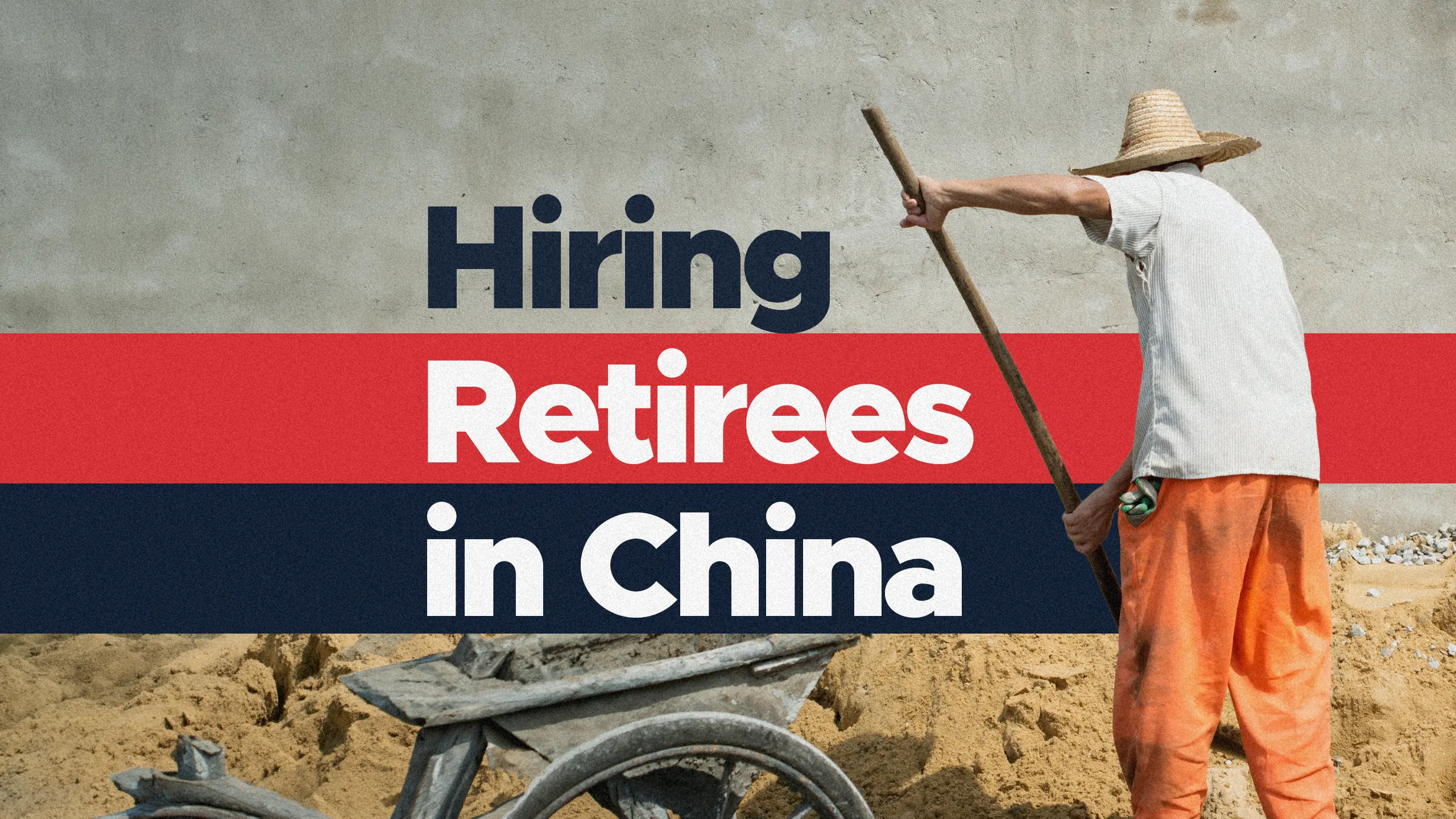
The Chinese government has granted people who work past retirement age new legal protections, ensuring them a minimum wage, limiting their working hours, and covering workplace injuries.
The rules, which took effect on 1 July, stop short of making these workers ordinary employees. But they close a gap that had left millions with almost no recourse when employers withheld their wages or a workplace injury put them out of work.
If you employ staff in China, it’s worth knowing these new rules. This is because your most experienced staff will hit retirement age well before their international counterparts.
Before the reform began, men retired at 60, women in office and professional jobs at 55, and women in manual jobs at 50. The increases started in January 2025 and run for 15 years, but even when they finish at the end of 2039 the ages will only reach 63, 58 and 55.
So a Chinese woman on a factory floor crosses the line more than a decade before her British counterpart.
The rules are called the Interim Provisions on the Protection of Basic Rights and Interests of Over-Age Workers, and five government bodies signed off on them in May, led by the labour ministry. That is a lot of signatures on one document, and it suggests the government intends to enforce it.
The arithmetic behind the new rules are straightforward: China’s workforce is shrinking and its retired population is growing fast. The pension system cannot absorb that ratio indefinitely. The government’s answer is to keep more older people working. That means raising the retirement age and making post-retirement work viable, rather than something people fall into informally.
The rules are good news for older workers, though they may add costs for employers. The higher retirement age could also pull grandparents out of a childcare system that depends heavily on them. Fewer available grandparents could mean fewer babies.
What Was Broken
Before these new rules, Chinese law stripped you of employee status the moment you reached retirement age or started drawing your pension.
There was one exception: Since January 2025 you can stay on as a normal employee for up to three more years, but only if your employer agreed. So most people who carried on working — and millions did — did it on a service contract, which is closer to being a freelancer than an employee.
The problem was service contracts sit outside labour arbitration. They carry no minimum wage floor and no work injury cover. Workers had to sue in a civil court, which is slow and expensive enough that most never bothered.
The result was predictable. Wages went unpaid, people were put on jobs they were not fit for, and injuries went uncompensated. Working past retirement age in China was, in short, a bad deal.
Judges could see the problem, and China’s top court had already started chipping away at it, creating dedicated categories for over-age employment disputes in 2025 and telling lower courts to stop automatically treating pensioners as freelancers. The new rules do the same job properly.
What the New Rules Do
Short of full employee status, the rules establish four protections that apply whatever the contract says:
Pay: At least the local minimum wage, paid in money rather than goods or accommodation, at least once a month and on time.
Hours and Leave: Normal working-hour limits apply and overtime is generally not allowed, but where it happens anyway it is paid at the full legal rate.
Safety: The job has to suit the worker’s physical condition, and employers cannot hand them work that puts their health at risk.
Work Injury Insurance: The employer must enrol them and pay the premium, with the worker contributing nothing. The detail is still to come, though: the rules say the work injury measures for over-age workers will be issued separately, so how this works in practice will depend on later guidance and on local implementation.
There must also be a written agreement covering hours, pay, safety and insurance, so handshake deals are no longer enough.
Workers can now take these four categories to labour arbitration rather than a civil court. That route is faster and cheaper, and it was closed to them before. They can also report pay and hours violations to their local labour bureau. Separately, trade unions now have a duty to monitor employers and help workers bring claims.
Pension and medical insurance, however, remain optional. Workers already drawing benefits keep them, and others can pay in themselves. Employers may contribute but are not obliged to.
And anyone using China’s flexible option to delay retirement is not covered at all, staying an ordinary employee under ordinary law.
What it Costs Employers
These rules cost money, and employers will price that in. On minimum wage alone, firms that had been paying over-age workers 2,000 yuan ($296) a month must now top up to the local floor — 2,520 yuan in Shenzhen for example. Work injury premiums, previously zero, are added on top, as is overtime.
Analysts cited by Caixin expected the rules to raise business costs and trigger a temporary contraction in hiring of older workers.
The opposing reading, from the Shaanxi Yongjiaxin firm, is that the rules cut costs by capping employer liability. Over-age workers get the four protections, but they still do not count as ordinary employees. On that reading, it means no sick pay, no severance and no permanent contracts. Before the provisions, courts in some places were treating these workers as ordinary employees anyway, exposing firms to all of it.
Both can be right. Compared with what many employers were getting away with, costs go up. Compared with the risk of a judge deciding you had an employee all along, they go down.
What it Costs Everyone Else
One area where this could have an effect is China’s birth rate, though researchers disagree about how much.
Grandparents are, in practice, a significant part of China’s childcare infrastructure. Formal childcare is expensive and thinly distributed, and intergenerational care is a long-standing family norm. Research using China Family Panel Studies data found that families relying on grandparental childcare had roughly four times the odds of having a second child compared with those that did not.
Keep grandparents at work and that surely raises the cost of having a child. One 2025 study modelled what a five-year delay in retirement would do and found that families would have slightly fewer children.
One finding runs the other way, though. A study of internal migrant families found that when parents retired, their children’s fertility intentions fell by 34.4%. The mechanism was income rather than time. Retirement ends the flow of money from one generation to the next, household finances tighten, and the tighter they get, the weaker the intention to have children.
So there are two forces pulling in opposite directions: retired grandparents have time but less money, working grandparents have money but less time, and which one wins depends on the family. That’s a question nobody has settled.