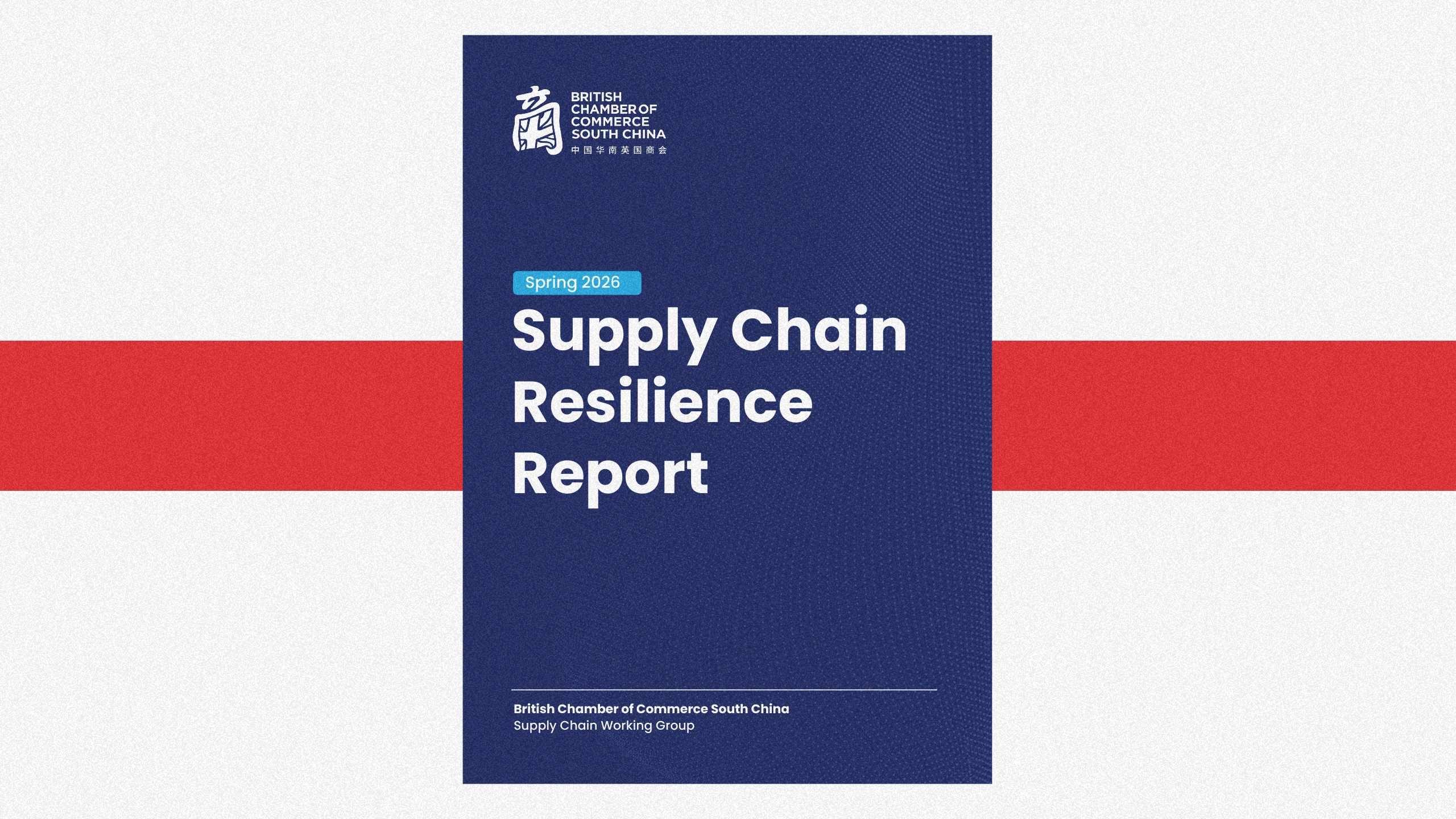
More than 80% of businesses with exposure to China-linked supply chains plan to maintain or expand their operations over the next three years, according to a report published by the British Chamber of Commerce South China.
None of the 50 firms surveyed plan to exit.
The report, produced with support from the U.K. Department for Business and Trade and Kinyu, found that geopolitical tensions and policy uncertainty ranked as the top source of disruption, cited by 52% of respondents. Tariffs and trade restrictions followed at 50%.
But the survey suggests the damage comes less from the tariffs themselves than from their unpredictability. Nearly half of respondents — 46% — said uncertainty about future policy was the single biggest barrier to building supply chain resilience.
“We can absorb a tariff. What we cannot absorb is not knowing whether it will still be there next month,” one senior logistics executive said at a roundtable in Guangzhou.
Benjamin King, CEO of Kinyu and chair of the BritCham South China Supply Chain Working Group, said the findings reflect a business community that is adapting rather than retreating. “China’s role in global supply chains remains structural,” he noted, pointing to the report’s finding that more than half of respondents primarily rely on China for sourcing. Of those that have diversified to Southeast Asia, several reported costs 10–15% higher and continued dependency on Chinese raw materials upstream.
One in four firms reported making no supply chain adjustments in the past 12 months. The most common response among those that did act was increased monitoring of geopolitical risk, cited by 32%.
The report also found that net zero commitments are increasingly tied to supply chain operations. Roughly 85% of carbon emissions for global supply chain firms sit in Scope 3 — embedded in purchasing, supplier operations and logistics. No Chinese company has yet certified through BSI’s net zero pathway standard.
The findings draw on the survey of 50 firms, three roundtable discussions with over 60 supply chain leaders across Shenzhen, Guangzhou and Shanghai, facility visits, and a Net Zero Conference held in Guangzhou on March 10, 2026.