
Almost all air traffic between Europe and Asia is now funnelling through a strip of airspace barely 50 miles wide, wedged between the Armenia-Azerbaijan border and Iranian skies that are shut to civilian flights.
Eight countries closed their airspace within 48 hours of the U.S.-Israel strikes on Iran launching on Feb. 28. Dubai International, the world’s busiest airport for international passengers, took a direct hit from Iranian missiles. Doha and Abu Dhabi shut down. More than 21,000 flights were cancelled.
Emirates, Etihad and Qatar Airways, carriers that between them handle up to a quarter of all passenger capacity between Europe and Asia, were largely grounded.
The Baku Bottleneck
With Russian airspace closed to most Western carriers since the 2022 Ukraine invasion, and the southern corridor through Turkey, Iraq and Iran now blocked, the only viable route linking Europe to Asia for non-Russian-friendly airlines runs through a narrow strip of airspace above the Caucasus.
Flightradar24 data shows traffic through Azerbaijani airspace surging since the conflict began. But the corridor’s reliability was called sharply into question on March 5 when Iranian drones crossed the border and struck the terminal building at Nakhchivan International Airport in Azerbaijan’s exclave region, injuring two civilians. Azerbaijani President Ilham Aliyev called it “an act of terror” and placed the country’s military on full combat readiness.
Azerbaijan closed its southern airspace in response. The main overflight routes through the north stayed open, but the point was made. This is not a stable corridor. Armenia and Azerbaijan fought a full-scale war in 2020 that shut large areas of airspace across the region. Border clashes in 2022 closed cross-border waypoints again.
Put simply: the Baku corridor is the world’s last functioning air bridge between Europe and Asia. And it runs through one of the most volatile border regions on the continent.
Passenger Fares and Route Chaos
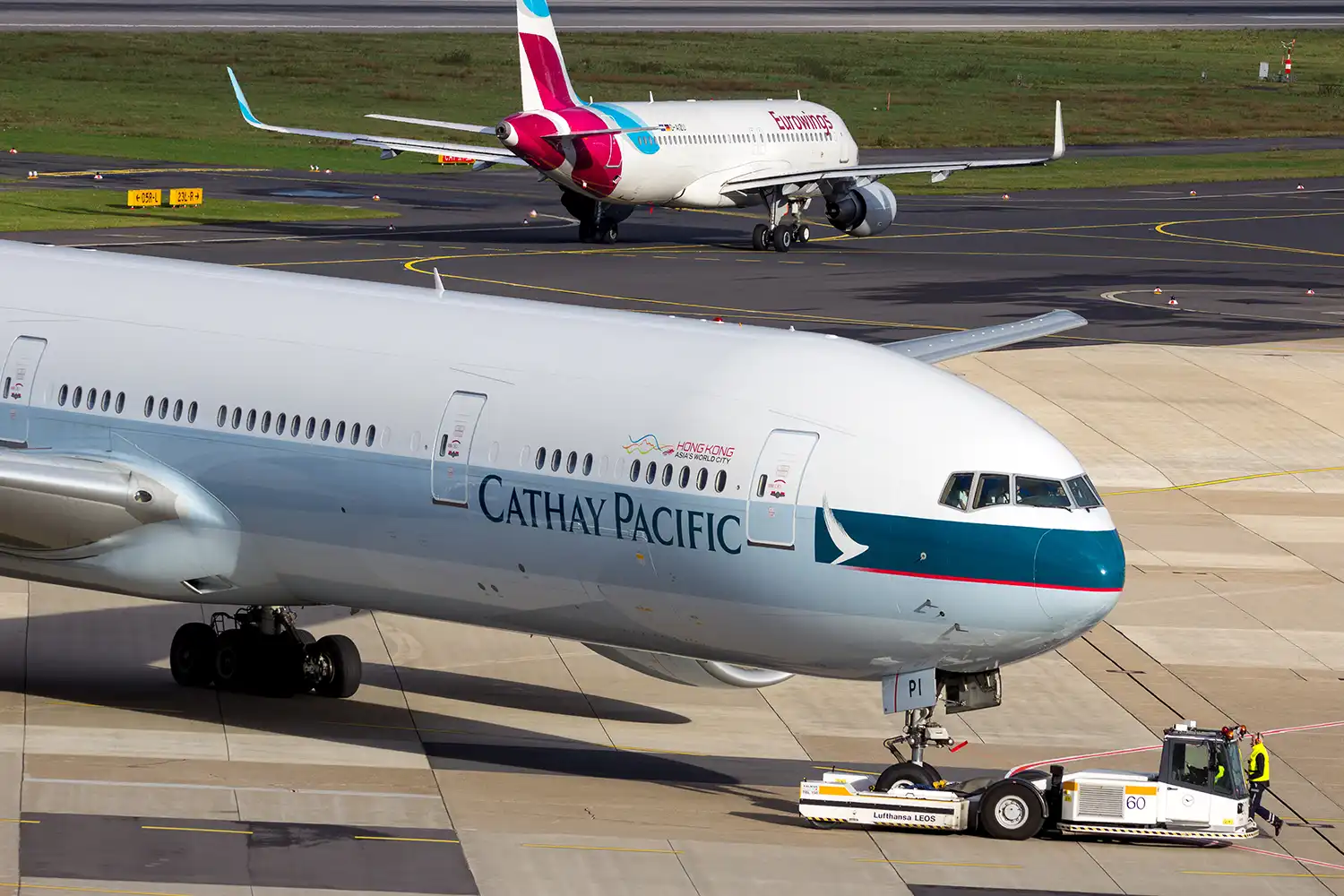
For anyone who needs to travel to China for business, the immediate concern is cost. Fares on what remain of the available routes have surged. Cathay Pacific economy seats from Hong Kong to London sold out for days. When they reappeared, one-way tickets hit $6,850.
And fares are climbing not just because of demand to China. They’re climbing because airlines that fly to China are now absorbing traffic that has nothing to do with China.
For instance, Hong Kong is taking on a massive amount of traffic that would have flowed through Dubai, Doha and Abu Dhabi. For Australians and Kiwis heading to Europe, Cathay via Hong Kong, Singapore Airlines via Changi, or the Chinese carriers are really the only games in town right now. That means more competition for every seat transiting the region, whether you’re heading to Guangzhou or just passing through.
HSBC analysts predict Hong Kong premium-class yields could remain 30-40% above 2025 averages through the summer peak.
Those booking through Western carriers should also factor in the risk that this situation could deteriorate further at short notice. If the Baku corridor closes, Western airlines will have almost no viable route to Asia at all.
Anyone who absolutely needs to be in China on a specific date should probably fly with a Chinese carrier that can transit Russian airspace. Air China, China Eastern, China Southern and Hainan Airlines bypass the affected corridors entirely.
For businesses in South America with China operations, the transpacific route via North American hubs avoids the affected airspace entirely and is probably the most dependable option right now. Connecting through Los Angeles, San Francisco or Vancouver to pick up a direct Pacific crossing sidesteps the Middle East and Caucasus corridors altogether.
Broader Implication
However, the broader question for businesses with China operations goes beyond ticket prices. Two of the three major east-west air corridors have now failed in the space of four years. The third is a sliver of Caucasus airspace that just took a drone strike. Anybody with a China supply chain has spent the past five years learning that shipping routes are not as reliable as they once assumed. The same lesson now applies to air travel.
If a key supplier meeting, a Canton Fair visit or a factory audit depends on someone flying in from Europe next month, it is worth asking: what happens if they can’t get there? If the answer exposes a gap in your China operation, it might be time to stop assuming the flights will always be there, and start investing in people who are already where the work is.